How the Discrete Element Method Revolutionizes the Study of Earth Pressure Balance (EPB) Tunnel Boring Machines
- VirtualCAE
- 24/11/2025
- Blog
- CAE, Discret Element Method, EDEM
- 0 Comentários
In mining and underground construction, excavating the subsurface safely and efficiently remains one of today’s greatest engineering challenges. When tunneling beneath urban areas or through unstable ground, the behavior of the soil — often composed of granular and heterogeneous materials — creates complex conditions of pressure, flow, and stability.
Earth Pressure Balance Tunnel Boring Machines (EPB-TBMs) have become one of the most effective solutions for this type of excavation, maintaining ground stability by controlling the face pressure as the tunnel advances. Yet, understanding what truly happens inside the excavation chamber, how the soil moves, how particles interact with cutters, scrapers, and the screw conveyor, has long been difficult, limited to indirect measurements or costly experimental testing.
This is where the Discrete Element Method (DEM) brings a true revolution. By enabling the simulation of each particle’s behavior and its interaction with machine components, DEM provides a new perspective for studying and optimizing EPB-TBMs. Using Altair EDEM, engineers can visualize, analyze, and predict machine performance under realistic conditions, reducing uncertainty, costs, and operational risk.
In this context, the Discrete Element Method (DEM)
has established itself as a revolutionary tool. By enabling the simulation of the individual behavior of each particle and its interactions with the machine components, DEM opens a new perspective for studying and improving EPB tunnel boring machines. Through Altair EDEM, engineers can visualize, analyze, and predict the performance of these machines under realistic conditions, reducing risks, costs, and design uncertainties.
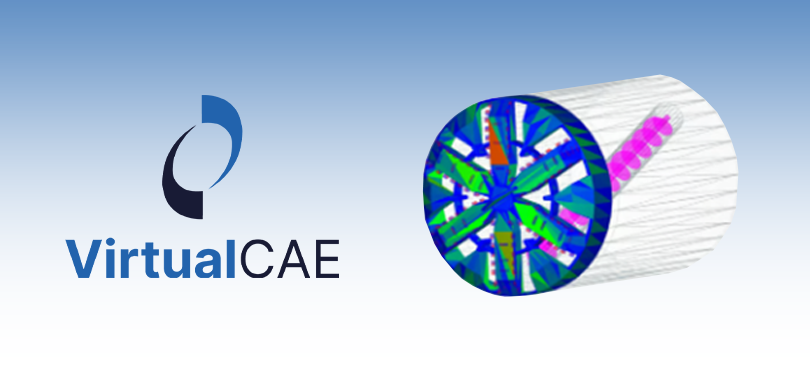
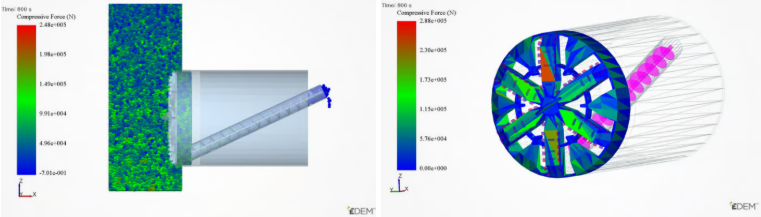
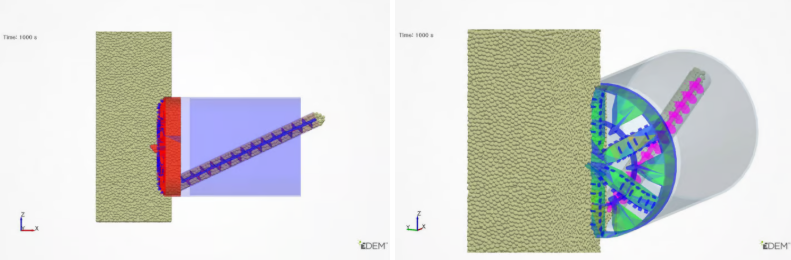
In this scenario, Altair highlighted a highly relevant study titled “Numerical Study of Face-Plate-Type Earth Pressure Balance Shield Tunnel Boring Machine with Discrete Element Method,” which demonstrates the use of Altair EDEM (based on the Discrete Element Method, DEM) to simulate the performance of an Earth Pressure Balance Tunnel Boring Machine (EPB-TBM). The study offers an unprecedented view of what happens inside the machine during excavation, revealing details that were previously accessible only through direct observation or complex field testing.
EPB Tunnel Boring Machines and the Challenge of Pressure Balance
EPB-TBMs are widely used in both urban and mining tunneling projects, where controlling face pressure is essential to prevent collapses and maintain ground stability. Their principle is based on balancing the earth pressure with the excavated material, which is temporarily stored in the excavation chamber and transported by a screw conveyor (auger). Numerically modeling this interaction between fragmented soil and the internal components, such as the face plate, scrapers, cutters, and conveyor screw, is a complex task. This is precisely where DEM simulation becomes indispensable.
Granular Simulation: Seeing the Invisible
The study used Altair EDEM to simulate a full-scale tunnel boring machine (6.64 m in diameter) with detailed structural representation of the cutting face, including 37 pre-cutters and 98 scrapers per radius. The simulation enabled the analysis of: pressure distribution on the excavation face, head torque under different rotation speeds, excavated material removal and discharge rate, regions of accumulation, flow, and compaction inside the chamber.
These results provided a detailed understanding of how operating conditions influence both pressure balance and the overall performance of the tunneling machine.
Although the study’s main focus was on urban environments, its findings are highly relevant to underground mining operations, where the behavior of fragmented soil and materials is equally complex. Mining engineers can use this approach to: optimize excavation progress and reduce unnecessary head torque, predict critical wear zones and improve component design, avoid clogging and bottlenecks in transport systems, simulate different geotechnical conditions and operational strategies before field execution.
The results showed that increasing cutterhead rotation raises face pressure and required torque. The discharge rate of excavated material varies with excavation speed, directly affecting pressure balance and stability control. The simulation also identified granular flow patterns inside the chamber, allowing optimization of the face plate and screw conveyor design.
These findings reinforce the value of DEM as a strategic tool for design and operational decision-making. The adoption of numerical methods like DEM is transforming how engineers plan and execute underground projects. With Altair EDEM, it is possible to integrate granular simulations with structural, thermal, and motion analyses, creating a complete digital ecosystem that connects material behavior, machine performance, and process efficiency.
For mining engineers, this means greater predictability, improved performance, and enhanced operational safety. The highlighted study demonstrates how granular simulation can unveil complex phenomena and optimize the performance of critical equipment such as EPB-TBMs. Using Altair EDEM, engineers can visualize what happens inside the excavation face, where particles interact, compact, and flow, and transform that knowledge into a technical and competitive advantage.
Related Posts