Solar Panel Impact Simulation: How VirtualCAE Evaluates Structural Resistance
- VirtualCAE
- 23/06/2026
- Blog
- English, FEA, HyperMesh, HyperWorks, Radioss
- 0 Comentários
How we predict damage in photovoltaic modules, reduce physical testing, and increase design reliability through explicit impact simulation.
Introduction
The rapid expansion of solar energy has driven the development of increasingly efficient and durable photovoltaic modules. However, continuous exposure to environmental conditions subjects these systems to various types of loading, including hail and bird impacts, which are considered among the primary threats to the structural integrity of solar panels.
In regions prone to severe storms, hail impacts can cause significant damage to the protective glass, generate microcracks in photovoltaic cells, and compromise the system’s energy performance over time. Given this scenario, manufacturers and developers seek more efficient methods to assess module resistance during the early stages of product development.
Computational simulation has emerged as a strategic solution for virtually reproducing these events, allowing engineers to analyze the structural behavior of panels under different impact conditions without requiring multiple physical prototypes. Using tools such as Altair HyperWorks, VirtualCAE’s engineering team can predict failures, reduce development costs, and improve product reliability before manufacturing.
Although solar panels are designed to withstand adverse environmental conditions, extreme weather events can generate loads far exceeding those encountered during normal operation.
The severity of hail-induced damage depends on several factors, including hailstone size, impact velocity, front glass thickness, photovoltaic cell type, module lamination process, frame structural configuration, and panel installation angle.
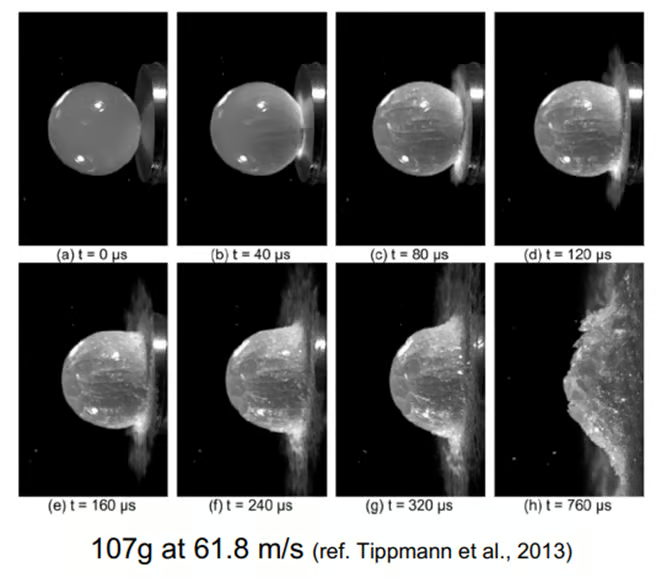
Global kinematics of a hailstone – By Siemens
Even when visible glass breakage does not occur, impacts may generate microcracks within solar cells, resulting in gradual efficiency loss and reduced system lifespan.
The use of structural simulations enables engineers to virtually reproduce impact scenarios and understand the behavior of photovoltaic module components during the event. Key benefits include reduced dependence on physical prototypes, early identification of design flaws, evaluation of alternative structural configurations, lower development costs, accelerated validation cycles, and improved reliability of final products.
Additionally, computer-aided engineering allows dozens of scenarios to be evaluated within a short period of time—something impractical using conventional physical testing methods.
VirtualCAE Simulation Workflow
This application demonstrates the HyperWorks ecosystem for analyzing hail impact on a complete solar panel. The process is divided into three main stages:
Model Preparation with HyperMesh
The first stage consists of geometry preparation and finite element mesh generation. Advanced HyperMesh capabilities enable:
- Automatic recognition of similar components through ShapeAI;
- Automated mesh generation using BatchMesher;
- Rapid creation of structural connections through Connectors.
These features significantly reduce model preparation time while ensuring greater consistency across multiple simulation studies.
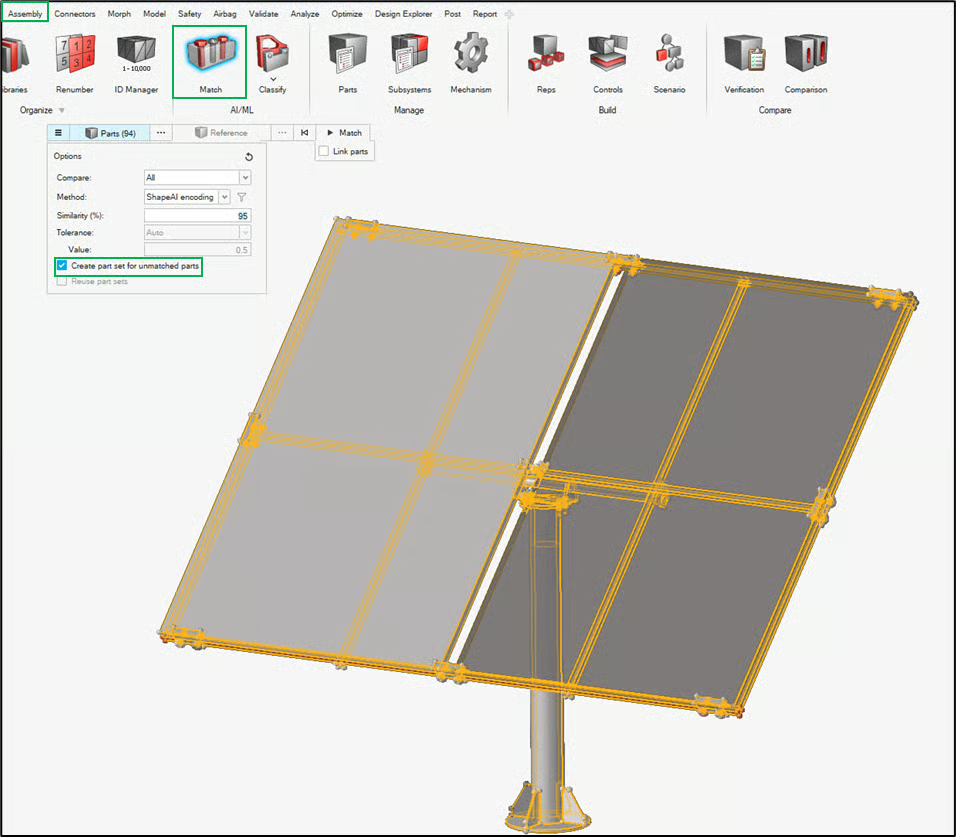
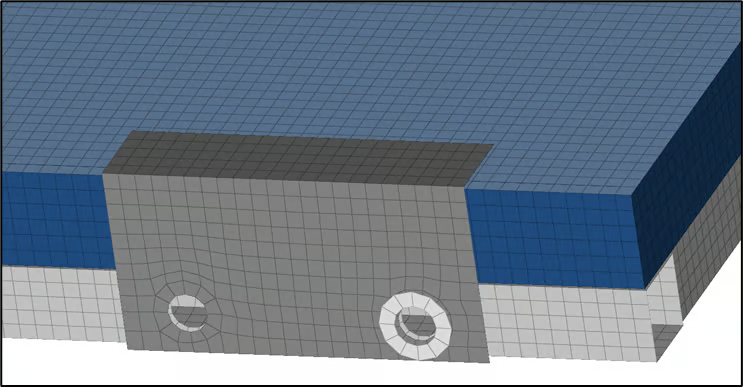
Geometry preparation – By Siemens
Dynamic Simulation with Radioss
After model preparation, the analysis is performed using the Radioss explicit solver, widely used for highly dynamic events. Radioss can accurately represent complex phenomena such as:
- Contact interactions between bodies;
- Large deformations;
- Material fracture;
- Energy absorption during impact;
- Nonlinear material behavior.
How VirtualCAE Evaluates the Results
Once the analysis is completed, results are assessed using HyperView. The software enables visualization of:
- Stress distribution;
- Deformation fields;
- Damage propagation;
- Glass behavior;
- Structural response of the frame.
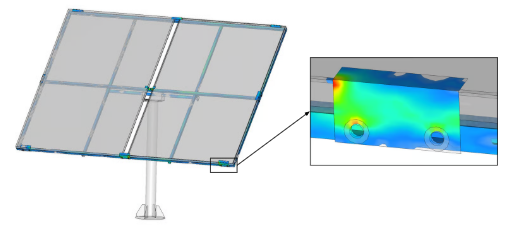
Stress levels in solar panel components after impact – By Siemens
This stage provides critical information for engineering decision-making and design optimization.
Key Results Observed
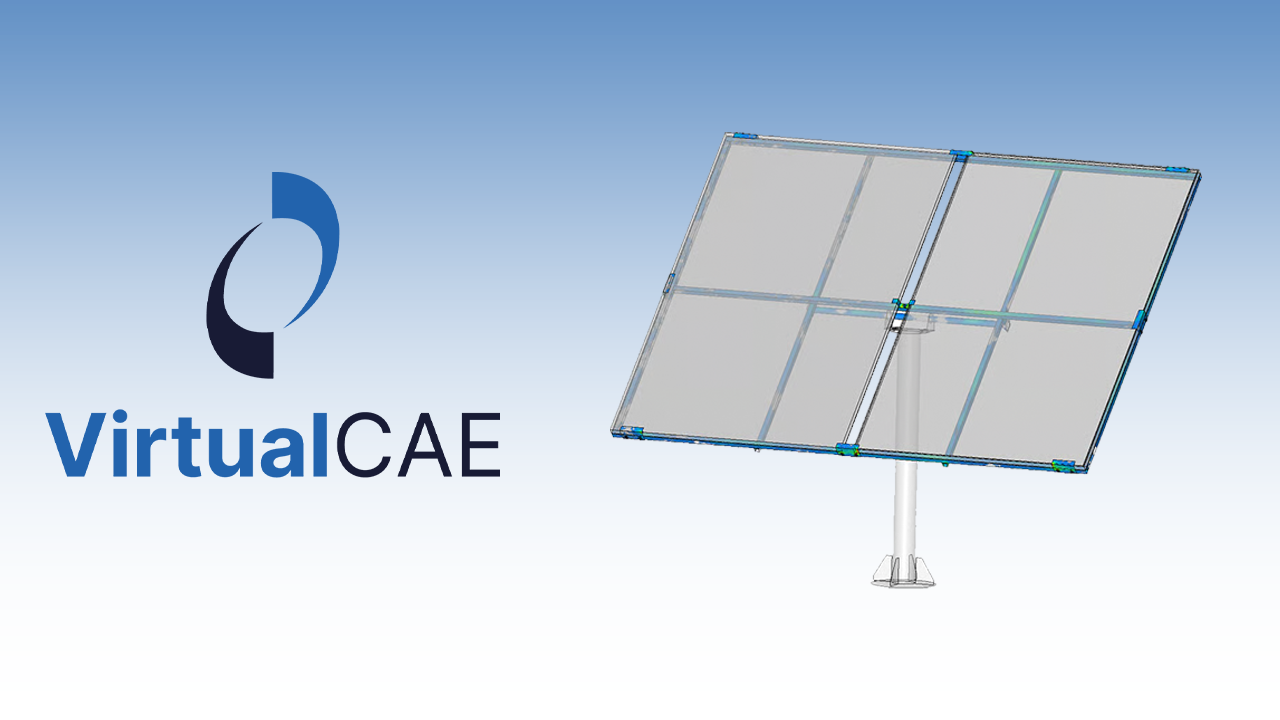
The analysis demonstrated that hail impact caused localized damage in the impacted region of the front glass, allowing engineers to visualize crack evolution and stress distribution throughout the entire event.
Meanwhile, the panel’s structural components exhibited stress levels below the material yield limits, indicating that the primary structure remained intact even after impact. This type of information is extremely valuable for manufacturers, as it enables identification of components that require reinforcement and those that already possess sufficient strength to withstand severe operating conditions.
Conclusion
As solar energy continues to establish itself as one of the world’s leading renewable energy sources, ensuring the durability and reliability of photovoltaic modules becomes a strategic priority for manufacturers and developers.
The solar panel impact simulation work performed by VirtualCAE provides an efficient approach for evaluating panel resistance under severe events such as hailstorms. Through the integration of HyperMesh, Radioss, and HyperView, engineers can predict failures, understand damage mechanisms, and optimize designs during the earliest stages of development.
In addition to reducing costs and accelerating the validation process, simulation enables the development of more robust, reliable products capable of withstanding the challenges imposed by real-world environmental conditions, contributing to the safe and sustainable expansion of solar energy.
Related Posts

5 Conceitos Básicos para Dominar a Análise Estrutural de Elementos Finitos: Da Teoria à Simulação
- VirtualCAE
- 23/08/2023
1. Estudar os Fundamentos Teóricos: Comece pelo alicerce! O primeiro passo para dominar a aná ..
Engenharia, Simulação e Inovação no Setor Agrícola
- VirtualCAE
- 25/11/2022
O desenvolvimento da agricultura moderna está diretamente ligada à evolução da sociedade co ..