Simulation for ECE R66 Regulation: how VirtualCAE uses CAE to assess the structural strength of vehicles
- VirtualCAE
- 06/10/2026
- Blog
- CAE, English
- 0 Comentários
How computational simulation can assist in the development and evaluation of rollover protection structures
Introduction
The structural safety of passenger vehicles is one of the main challenges in automotive development. In rollover situations, the strength of the vehicle superstructure is essential to preserve the space intended for occupants and reduce the risk of injuries.
In this context, the UN Regulation No. 66 (ECE R66) establishes provisions for the approval of large passenger vehicles with regard to the strength of their superstructure. The regulation is directly related to the structural capacity of the vehicle to withstand conditions associated with a rollover event.
The use of computational simulation based on the Finite Element Method (FEM) makes it possible to virtually analyze the behavior of the structure before conducting physical tests, helping to identify critical regions, evaluate deformations, and make design modifications.
It is in this context that VirtualCAE operates, using computer-aided engineering (CAE) tools to develop, analyze, and validate structural models according to the applicable requirements of the standard.
How does VirtualCAE perform the simulation for ECE R66?
The simulation process begins with the interpretation of the requirements of the standard and the definition of the conditions that must be numerically represented. Based on this information, VirtualCAE develops an analysis workflow that may involve the following steps:
1. Understanding the requirements
First, the requirements applicable to the vehicle and the structure to be analyzed are evaluated. Information such as: Vehicle characteristics; Superstructure configuration; Geometry and dimensions; Mass and mass distribution; Boundary conditions; Load cases; Evaluation criteria; Requirements related to the residual space for occupants. This step is essential to ensure that the computational model adequately represents the scenario specified by the regulation.
2. Structural modeling
The three-dimensional geometry of the vehicle and its superstructure is prepared for numerical analysis. Depending on the level of detail required, different components may be represented by shell elements, solids, or other idealizations appropriate to the problem.
Proper geometry preparation is an important step because details such as thicknesses, structural profiles, joints, and connection regions can significantly influence the behavior of the structure.
3. Generation of the Finite Element model
Next, the structure is discretized into a finite element mesh. The objective is to transform the continuous geometry into a numerical model capable of representing displacements, deformations, stresses, contacts, connection behavior, large deformations, when applicable, and material and geometric nonlinearities. Mesh quality is essential for obtaining reliable results. Therefore, structurally important regions may receive greater refinement.
4. Definition of materials and connections
The properties of the materials used in the structure are entered into the computational model. In addition to elastic properties, when necessary, nonlinear behaviors such as plasticity and hardening may be considered. The existing connections in the structure are also represented, such as welds, bolts, structural joints, and contacts between components.
This representation allows the virtual model to approximate the actual characteristics of the vehicle.
5. Application of loading conditions
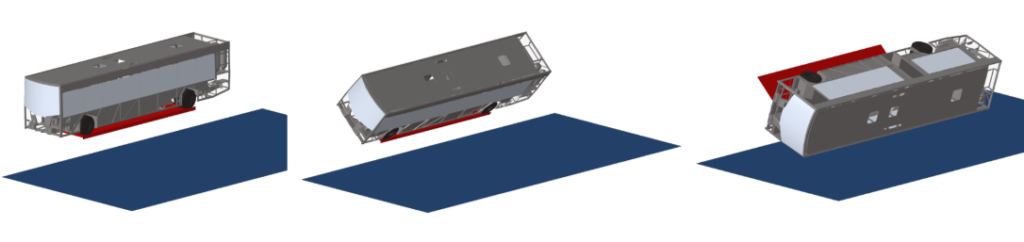
One of the most important steps is the application of the boundary conditions and loads defined for the evaluation. In the case of ECE R66, the evaluation is related to the strength of the superstructure under rollover conditions. The regulation establishes specific procedures and criteria for this evaluation. The simulation can be used to numerically represent the behavior of the structure during the event or to reproduce equivalent methodologies provided for in the regulation, when applicable.
6. Simulation execution
With the model prepared, the analysis is performed using a solver appropriate for the structural behavior considered. Depending on the case, analyses that consider large displacements, contact, and nonlinear material behavior may be required.
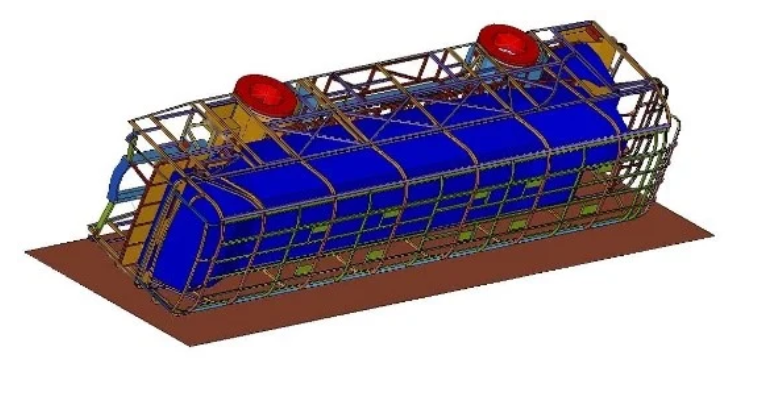
Durante a simulação são acompanhadas grandezas como deslocamentos, deformações, tensões, força de reação, energia, deformações plásticas, integridade estrutural e alteração no espaço residual.
During the simulation, quantities such as displacements, deformations, stresses, reaction forces, energy, plastic deformations, structural integrity, and changes in the residual space are monitored.
7. Evaluation of the results
After the simulation, the results are compared with the criteria defined for the evaluation. One of the fundamental points is to verify whether the deformation of the superstructure compromises the space intended for the survival of the occupants. In addition, the analysis makes it possible to identify critical regions of the structure and understand how different components participate in the absorption and transmission of loads. Based on these results, design changes may be proposed, such as:
-
Reinforcement of critical regions;
-
Modification of thicknesses;
-
Modification of profiles;
-
Modification of connections;
-
Repositioning of components;
-
Structural optimization.
Virtual simulation x physical testing
One of the major advantages of using CAE is the possibility of studying different design alternatives before building prototypes. For example, imagine a structure that exhibits excessive deformation during the simulation. Instead of immediately manufacturing a new prototype, the engineer can virtually modify the structure and perform a new analysis. It is possible to compare different solutions:
Original Design → Simulation → Identification of the Critical Point → Modification → New Simulation → Validation
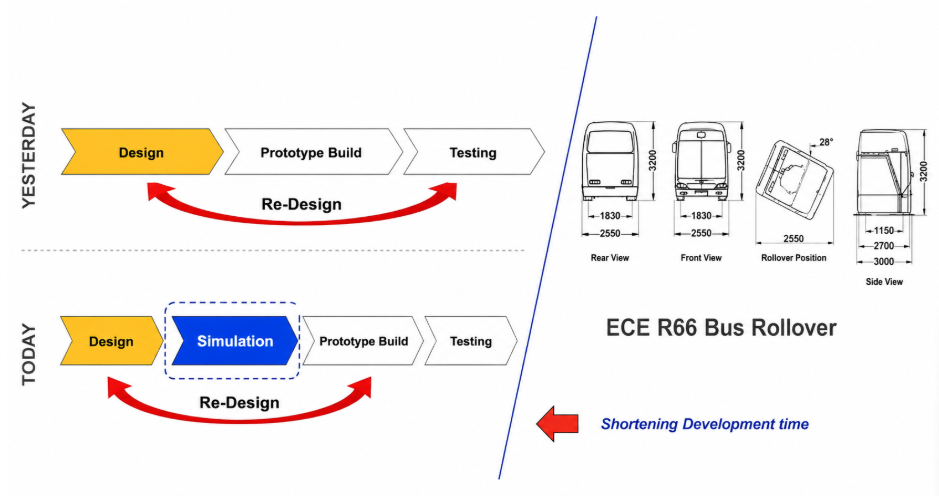
This process reduces the number of physical iterations and allows engineering decisions to be made based on quantitative data.
It is important to emphasize, however, that computational simulation should be used as part of an engineering and validation process. Formal compliance with homologation requirements depends on the correct application of the regulation, the necessary documentation, and the applicable approval procedures
Benefits of simulation with VirtualCAE
The application of CAE simulation during structural development provides several benefits:
Cost reduction
Problems can be identified while still in the virtual environment, reducing the need for successive modifications to physical prototypes.
Reduced development time
Different alternatives can be evaluated quickly, accelerating the development process.
Greater predictability
Simulation makes it possible to anticipate the behavior of the structure under the analyzed loading conditions.
Structural optimization
The design can be adjusted to find a balance between strength, safety, mass, and manufacturing.
Validation support
Numerical results can assist in the preparation and interpretation of physical tests and other stages of the validation process.
Conclusion
The application of the Finite Element Method in the evaluation of vehicle structures makes it possible to transform a complex engineering problem into a computational model capable of providing detailed information about structural behavior.
In the context of ECE R66, simulation can be an important tool for the development and evaluation of the strength of passenger vehicle superstructures, making it possible to identify critical regions, study deformations, and optimize the design before conducting physical tests.
VirtualCAE combines expertise in structural engineering, finite element methodology, and CAE tools to develop analyses focused on the specific needs of each project.
More than simply performing a simulation, the objective is to transform numerical results into engineering information that assists in decision-making, design optimization, and the development of safer and more efficient structures.
References
UNECE – United Nations Economic Commission for Europe. UN Regulation No. 66 – Uniform provisions concerning the approval of large passenger vehicles with regard to the strength of their superstructure.
UNECE – GRSG. Documents and proposals related to UN Regulation No. 66 and the strength of the superstructure of passenger vehicles.
Related Posts
Conheça os Tipos de Análise de Elementos Finitos
- VirtualCAE
- 04/09/2023
A análise por elementos finitos (FEA – Finite Element Analysis) é uma técnica computac ..

Agregue valor aos seus produtos com Simulação Virtual
- VirtualCAE
- 25/11/2022
A competitividade e o dinamismo do mercado exigem das companhias a preocupação em antecipar-s ..