Lattice-Boltzmann Method: Faster, More Accurate, and Scalable CFD Simulations
- VirtualCAE
- 16/07/2025
- Blog
- Altair, CAE, CFD, English, ultraFluidX
- 0 Comentários
Discover how the Lattice-Boltzmann Method is revolutionizing complex flow simulations with high computational performance
In the pursuit of more efficient, aerodynamically optimized products that better respond to real-world operating conditions, computational fluid dynamics (CFD) has become an indispensable ally for engineers and designers. Within this realm, the Lattice-Boltzmann Method (LBM) has been gaining increasing prominence as a revolutionary approach for analyzing complex flows, particularly in detailed geometries and automatically generated meshes.
Unlike traditional methods based on the Navier-Stokes equations, the Lattice-Boltzmann method models fluid behavior from a mesoscopic perspective. Instead of directly solving the flow equations, LBM simulates the movement and collision of groups of fictitious particles that move within a three-dimensional grid called a lattice. These particles follow simple rules and move in a statistical manner, based on probability distributions, meaning the method does not track each individual particle but rather their collective behavior. With each iteration, particles move to neighboring nodes and collide, exchanging information and forming the overall flow pattern. This approach allows for the natural and efficient capture of complex phenomena such as flow separations, vortices, and interactions with irregular surfaces, without requiring the user to spend extensive hours on mesh generation.
This way of computing flow, based on local interactions and simple rules, allows LBM to be inherently suited for parallel processing. This means it can run extremely efficiently on modern computing architectures such as GPUs, significantly reducing simulation time, even in cases involving complex geometries or large data volumes.
In this context, Altair ultraFluidX stands out as one of the most advanced solutions on the market. Based on the Lattice-Boltzmann Method, ultraFluidX enables large-scale transient CFD simulations with speed and precision. Its excellent computational scalability for GPU processing makes it possible to analyze entire vehicles, HVAC systems, industrial equipment, or even complex urban structures in reduced time.
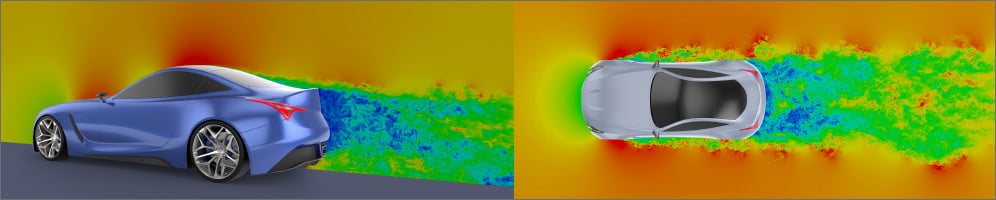
In addition to its high performance, ultraFluidX offers integrated capabilities for external aerodynamics, internal ventilation, heat exchangers, and can accurately capture complex phenomena associated with the relative motion between the ground and vehicles. This versatility enables more accurate decision-making from the earliest stages of design. With an automatically generated mesh directly from the CAD model, the software eliminates manual steps, reduces rework, and significantly accelerates the development cycle.
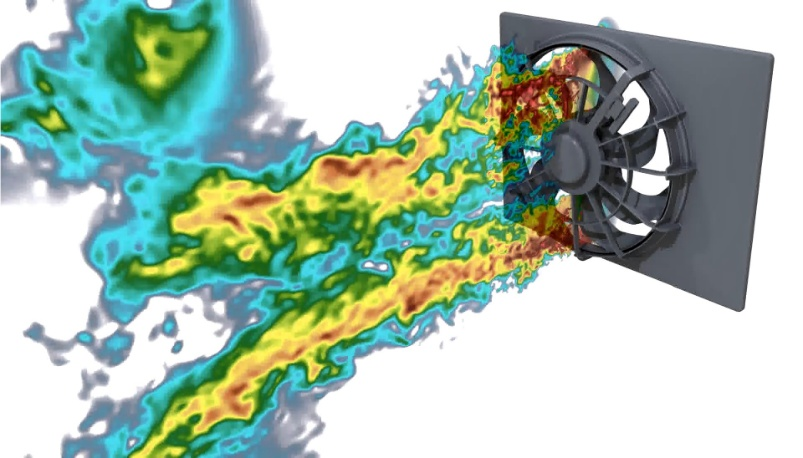
Combining physical robustness, processing speed, and ease of use, the Lattice-Boltzmann Method represents a new era in flow simulation. Its innovative approach paves the way for increasingly detailed, realistic, and accessible analyses, even in contexts previously considered challenging for traditional CFD. Whether to accelerate product development, reduce physical prototyping costs, or explore new design possibilities, LBM, especially in solutions like ultraFluidX, offers a powerful competitive advantage for those looking to innovate with confidence.
Get in touch and find out more about the services and products offered by VirtualCAE.
Related Posts