DEM Simulation of Granular Materials and Screens
Computational Simulation of Particulate Solids for Performance and Durability Assessment of Industrial Equipment
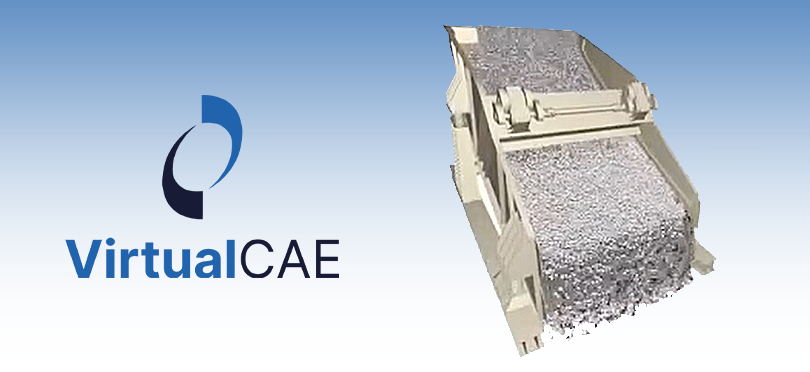
In process engineering, the handling of granular and bulk materials such as ores, soils, grains, fertilizers, and industrial powders represents a recurring challenge across multiple sectors, from mining to agribusiness and chemical industries. The collective behavior of these particles, governed by complex interactions involving contact, friction, cohesion, and energy dissipation, directly affects the efficiency, performance, and durability of industrial equipment. To better understand and optimize these phenomena, the use of numerical simulation methods based on the Discrete Element Method (DEM) has become essential. In this context, Altair EDEM stands out as one of the most robust CAE tools for analyzing and optimizing processes involving particulate solids, enabling detailed studies of screens, mixers, hoppers, conveyors, and other equipment subjected to complex granular flows.
Computational simulation with Altair EDEM allows engineers to observe and quantify the behavior of each individual particle in motion, revealing phenomena that would otherwise be extremely difficult to measure experimentally. Engineers can investigate flow patterns, segregation, clogging, deposition, and component wear, as well as evaluate the impact of different geometries, operating conditions, velocities, and material properties. These analyses are fundamental for predicting equipment performance and optimizing designs, reducing the need for time-consuming and costly physical testing, allowing virtual exploration of a wide range of design scenarios before prototype manufacturing, and accelerating the development cycle with data-driven insights.
The accuracy of a DEM simulation depends on the proper definition of particle-particle and particle-surface contact parameters, including restitution, friction, and stiffness coefficients. Moreover, particle sizing, granulometric distribution, and experimental calibration are critical steps to ensure that the model accurately represents the real physical behavior of the material. In coupled applications, Altair EDEM can be integrated with Finite Element Analysis (FEA) and Multi-Body Dynamics (MBD) tools, enabling the evaluation of stress and impact forces generated by particles on equipment surfaces. This coupled approach helps identify critical regions of fatigue, vibration, and wear, promoting more efficient and durable equipment designs.
The use of Altair EDEM delivers significant benefits throughout the entire development and operational chain — from reducing prototyping costs and time by replacing part of physical testing and allowing rapid design adjustments, to increasing operational efficiency and extending equipment lifespan through detailed analysis of flow and impact conditions that reveal critical areas for optimization. When integrated with other Altair tools such as Inspire, MotionSolve, and OptiStruct, EDEM provides a holistic view of the system, combining motion, impact, and structural response in a unified and coherent simulation environment.
Altair EDEM’s applications cover virtually all industries that handle bulk solids, including mining and metallurgy, with simulations of screening, crushing, and ore transport; agribusiness, with modeling of seeders, silos, and grain conveyors; construction, with analysis of aggregate and cement flow in machinery; and the chemical and pharmaceutical industries, with studies of powder mixing, granulation, and coating.
Granular material simulation with Altair EDEM is transforming how engineers design, optimize, and validate industrial equipment. By capturing previously invisible phenomena — the internal behavior of particles, their interactions, and impacts — it becomes possible to turn this knowledge into a competitive advantage, ensuring safer, more efficient, and more sustainable engineering designs.
Related Posts
Análise de Flambagem com OptiStruct: Métodos e Aplicações Práticas
- VirtualCAE
- 14/08/2025
Entendendo a Flambagem Estrutural A flambagem é uma instabilidade estrutural crítica caracter ..
Descubra a revolução gráfica de impacto do VS Visualizer Pro
- VirtualCAE
- 02/08/2024
Simulação profissional, gráficos de cinema! VS Visualizador Pro (VSV Pro) O VS Visualizer Pr ..