CFD Simulations for Fire and Smoke Propagation: Engineering Safety for Those Who Value Results
- VirtualCAE
- 26/06/2025
- Blog
- CAE, CFD, English
- 0 Comentários
Anticipate risks, protect lives, and reduce costs with advanced engineering solutions for fire safety.
(…)
Fire safety goes far beyond being just a regulatory requirement in construction and engineering projects. When the focus is on protecting lives and property, the commitment must be to effective solutions and well-founded decisions. In complex environments, especially those with high foot traffic or increased combustion risks, relying solely on traditional approaches may not be enough. That’s why CFD (Computational Fluid Dynamics) simulations have become an essential tool for those who want to anticipate risks and implement truly effective safety strategies.
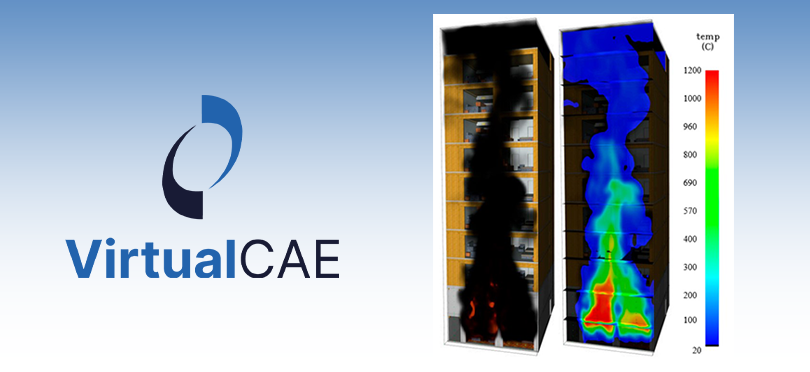
CFD simulations applied to fire and smoke propagation allow us to accurately predict how a fire will behave in a specific environment, whether in a commercial building, a road tunnel, a hospital, or an industrial facility. With this technology, we can visualize smoke behavior, identify critical heat accumulation points, and evaluate how ventilation and protection systems impact the overall safety of the project. This approach provides a new level of understanding, allowing designers, architects, and operators to make decisions based on concrete data, not just general assumptions.

Unlike analyses based solely on tables or simplified models, CFD offers a realistic view of the three-dimensional environment and how various elements interact during a fire. For example, it is possible to simulate a fire starting in a specific part of a warehouse and track, second by second, how the smoke would spread through hallways, stairwells, or shared spaces. We can also verify whether the placement of exhaust systems or fire barriers is sufficient to ensure safe evacuation. These answers are fundamental to transforming a project into an environment truly prepared for emergencies.
More than just complying with legal requirements, investing in this type of analysis is a smart risk management strategy. Changes made during the design phase of a project cost significantly less than modifications later on, when construction is already underway or even completed. Likewise, the technical reports generated by the simulations directly contribute to approvals by regulatory bodies, streamlining processes and adding credibility to the project.
The simulation process begins with the creation of a detailed three-dimensional model of the environment. Using project drawings and specifications, we incorporate all relevant elements for the study: walls, doors, windows, ventilation systems, equipment, and any other features that could influence the behavior of smoke and heat. Over this model, realistic fire scenarios are configured, defining the characteristics of the fire, heat release rate, and materials involved.
One of the great advantages of this approach is the ability to test different conditions, including failure situations, such as the non-activation of certain systems or blocked evacuation routes. This ensures that the project not only meets the required standards under ideal conditions but also provides robust safety even in adverse scenarios. After all, real fires don’t always follow the expected script and that’s precisely where predictive engineering proves its strength.
From the simulation results, we generate temperature maps, smoke concentration levels, and visibility charts over time. This data is presented in objective, clear, and well-founded reports, ready to support technical and strategic decisions. These reports also facilitate communication with the technical teams responsible for approvals and permits, offering legal and technical confidence to all stakeholders.
This type of analysis can be applied to a wide range of projects. In commercial buildings, for example, simulations help ensure that escape routes remain accessible long enough for safe evacuation. In road or rail tunnels, they enable an evaluation of ventilation system performance, ensuring that people can exit safely. Hospitals, distribution centers, industrial warehouses, and transportation terminals also benefit greatly, especially in situations involving large flows of people or high volumes of stored materials.
By investing in CFD fire simulations, you’re not just fulfilling a technical requirement, you’re actively protecting people, property, and operational continuity. This commitment demonstrates responsibility, adds value to your project, and builds trust with clients, investors, and regulatory authorities.
At VirtualCAE, we transform complexity into practical solutions. Our team combines experience in engineering with advanced technology to deliver accurate answers and safer decisions. With CFD simulations, you anticipate risks and build environments that are better prepared for the unexpected. Contact us and take your project to the next level of safety and efficiency.
Get in touch and find out more about the services and products offered by VirtualCAE. ✅
References
Hayajneh, Suhaib M., and Jamal Naser. “Fire spread in Multi-Storey timber building, a CFD study.” Fluids 8.5 (2023): 140.
Sumit Singh. “Variation of Visibility with Time in a Duplex for Multiple Fire Source”. Youtube, 10 Jun. 2015, youtu.be/Wm56jKyYrGs?si=jh8t7g_8UpRE-mqw.
Related Posts