Advanced simulation technologies are revolutionizing the development of lighter, more functional, and more comfortable knee prostheses.
When a person has impaired knee mobility, one of the greatest challenges is enabling them to walk naturally and comfortably again. A knee prosthesis is not just a “mechanical part”: it must replicate complex motion, support body loads, provide stability, and remain lightweight to reduce user effort while walking. Advances in technology and computational simulation have allowed engineers to develop increasingly better prosthetic knees even before producing a physical part.
History and evolution of knee prostheses
Originally, knee prostheses were simple, with a single axis of motion that helped amputees walk, but required an unnatural gait pattern and were far from the functionality of a real human knee. Over time, polycentric knees were developed, improving stability and range of motion, but often at the cost of greater complexity and weight. Today, modern materials such as reinforced plastics, aluminum, carbon fiber, and titanium make these mechanisms both functional and lightweight.
Currently, there are prostheses equipped with motors, hydraulic or pneumatic actuators, and microprocessors capable of collecting data from the user’s gait pattern and automatically adjusting motion, making walking more natural and efficient.
Multibody simulation and its importance
One of the most powerful tools for developing these systems is multibody dynamics (MBD) simulation. It allows engineers to create a virtual model of a knee prosthesis and simulate different gait patterns or activities, such as climbing stairs or walking on varied terrain. This makes it possible to test control algorithms and evaluate design performance without risk to the user and before building physical prototypes.
How Inspire Motion is used in the design
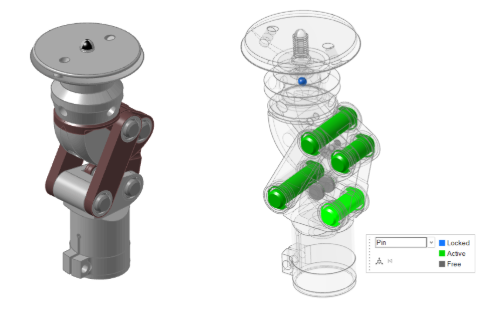
Altair Inspire Motion simplifies the creation of a knee prosthesis model and supports several development stages, such as importing and creating knee geometry in a virtual environment; constraining the model and defining rigid parts with no relative motion; automatic detection of joints and articulations using intelligent tools; creation of actuators to define how the knee moves under body loads during gait; and motion simulations to evaluate system behavior.
Knee prosthesis model for optimization – by Altair
Component optimization
After assembling the basic model, individual parts can be optimized to reduce weight or improve performance:
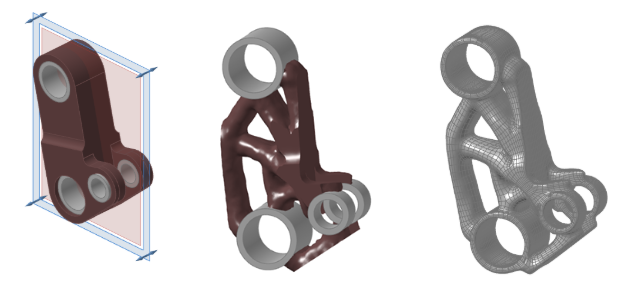
Design spaces are created on the parts to be optimized;
Components are separated where joints exist;
Shape controls ensure the optimized geometry is suitable for manufacturing (such as molding, extrusion, or 3D printing).
For example, one prosthetic component was optimized from 49 g to 27 g, reducing mass while maintaining or improving the mechanical properties required for real-world use.
Mass optimization process of the model – by Altair
Results and real-world impact
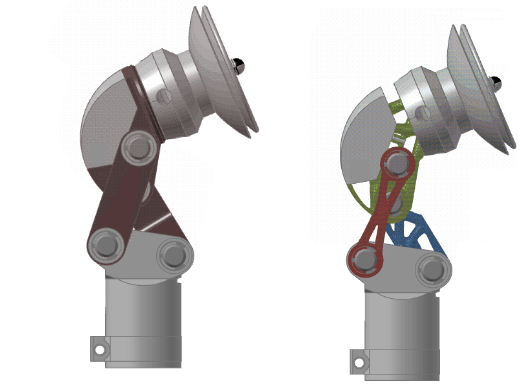
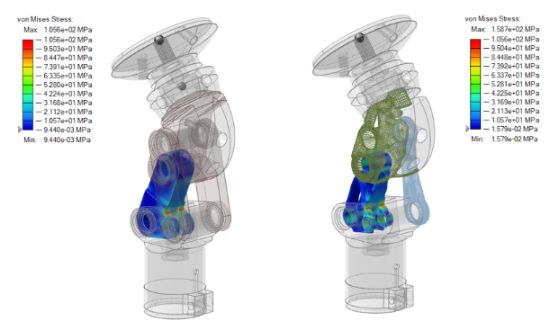
Using simulation data, a complete prosthetic assembly reduced its total weight from 540 g to 433 g—nearly a 20% mass reduction—without compromising structural strength under walking loads. The analyses also allow visualization of forces and torques acting on joints and components, enabling further design refinement and prediction of stresses during different movements.
Motion visualization before and after optimization – by Altair
Conclusion
Knee prostheses have evolved from simple mechanisms into complex systems integrating electronics, actuators, and advanced simulation software. Tools such as Altair Inspire Motion, leveraging multibody dynamics, optimization, and structural analysis, enable engineers to develop lighter, more efficient prostheses tailored to user needs—all before manufacturing. This approach reduces costs, increases safety, and improves the quality of life for those who rely on these technologies for mobility.
Baseline stresses in the knee (left) | Optimized stresses in the knee (right) – by Altair