How computational simulation anticipates wear zones and increases reliability in slurry transport.
(…)
The hydraulic transport of mineral slurries is widely used in mining due to its safety, cost-effectiveness, and efficiency in moving large volumes of solids. Despite these advantages, a critical challenge remains: the erosion of pipelines caused by the continuous impact of abrasive particles within the flow. Anticipating where this wear occurs is essential for reducing maintenance costs and increasing operational reliability. Computational Fluid Dynamics (CFD) has become a key tool in achieving this goal.
Slurry behavior varies according to particle size distribution, concentration, and flow velocity. As discussed by Messa et al. (2021), the flow may occur in pseudo-homogeneous, heterogeneous, or fully stratified regimes. At higher velocities, particles lift from the bottom bed and begin to collide with the pipe wall, intensifying wear, especially in bends, reducers, and fittings.
The main advantage of CFD is its ability to provide detailed, local information about the flow. While traditional models offer only global averages, CFD reveals particle concentration patterns, collision frequency, and regions with higher erosion risk. This makes it possible to assess operational changes such as velocity adjustments, concentration shifts, or geometry modifications before implementing them in real systems.
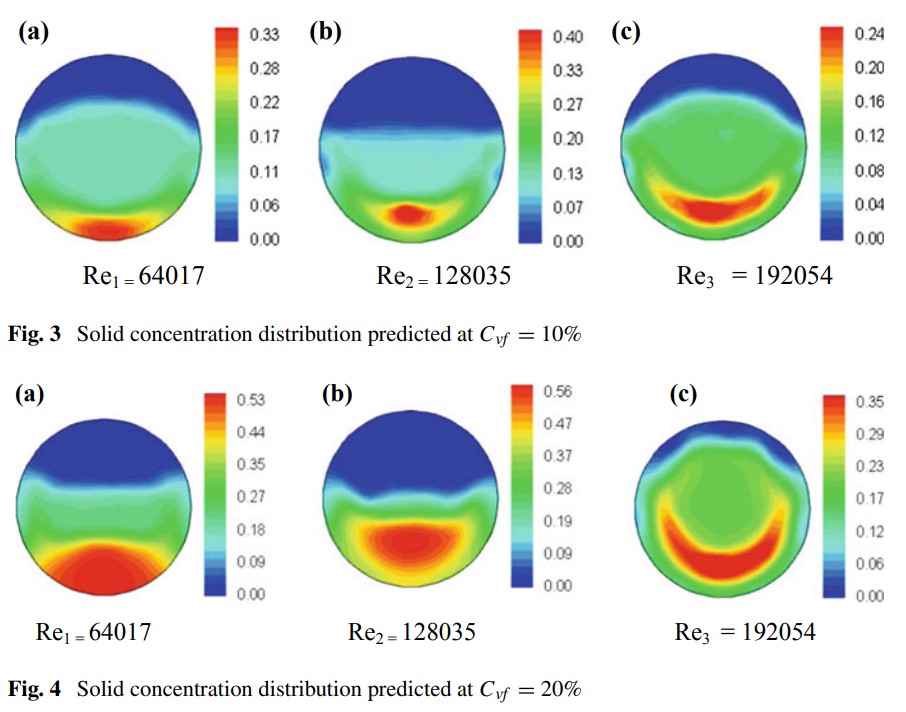
Solid fractions contours on slurry pipeline (Parkash et al.).
Two main approaches are used to model particle behavior. The Eulerian–Lagrangian approach tracks each particle or parcel within a continuous fluid field and is the most applied in erosion studies because it allows direct calculation of impact energy and angle at the wall. The Eulerian–Eulerian approach treats the solid phase as a granular fluid and is suitable for higher concentrations, although less effective for detailed erosion prediction.
Once particle trajectories are obtained, empirical erosion models such as Finnie, Oka, or E/CRC are used to estimate wear rates. These models relate relative velocity, impact angle, material hardness, and particle characteristics. Industrial pipe bends often show higher erosion due to grazing impacts driven by particle inertia, especially when particles are denser or larger.
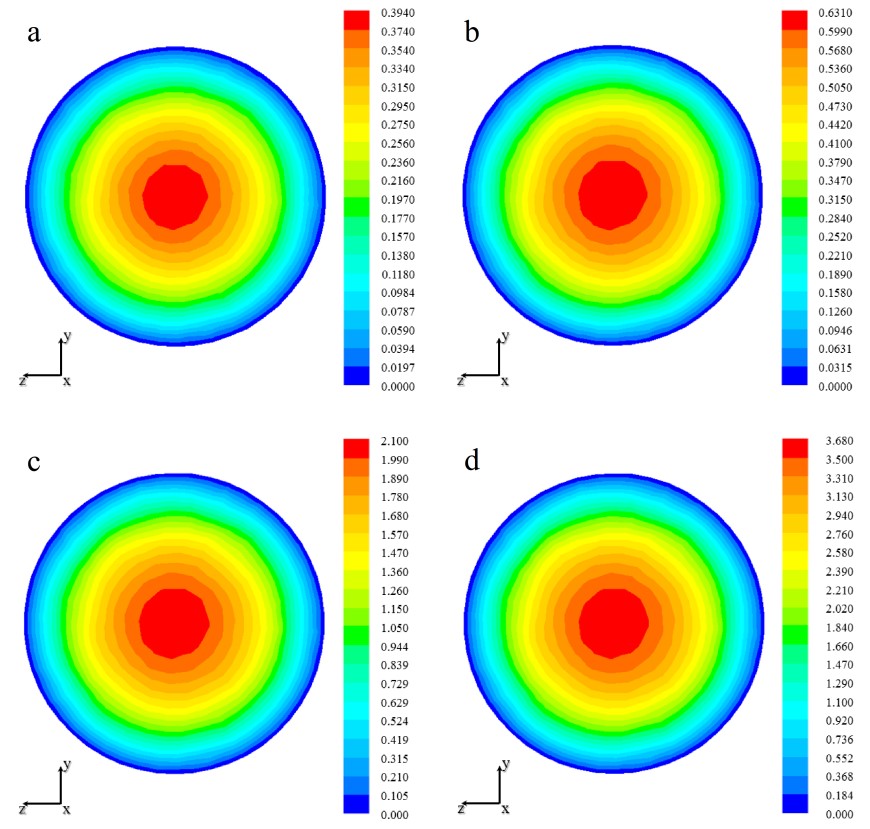
Velocities contours on slurry pipeline for various solid concentrations (Zambrano et al.).
Messa et al. highlight that accuracy in CFD simulations depends strongly on the choice of drag model, the treatment of particle collisions, and the mesh resolution. There is a critical zone when the numerical cell size approaches the particle diameter, which can compromise the precision of force models and alter wear predictions. Experimental validation remains essential to ensure that the model represents the correct physical mechanisms rather than only average values.
In mining operations, CFD is widely used to identify critical wear regions, refine bend and reducer geometries, evaluate alternative materials, and define minimum transport velocities that avoid particle deposition. These analyses increase pipeline lifespan, reduce unexpected failures, and improve maintenance planning.
In complex slurry transport systems where operational availability is vital, CFD has become a strategic tool. By revealing details that cannot be observed directly, it enables more precise and safer decisions, contributing to more efficient and reliable operations.
Messa, G. V., Yang, Q., Adedeji, O. E., Chára, Z., Duarte, C. A. R., Matoušek, V., Rasteiro, M. G., Sanders, R. S., Silva, R. C., & de Souza, F. J. (2021). Computational Fluid Dynamics Modelling of Liquid–Solid Slurry Flows in Pipelines: State-of-the-Art and Future Perspectives. Processes, 9(1566).https://doi.org/10.3390/pr9091566
Parkash, O., Kumar, A., Sikarwar, B.S. (2019). CFD Modeling of Commercial Slurry Flow Through Horizontal Pipeline. In: Kumar, M., Pandey, R., Kumar, V. (eds) Advances in Interdisciplinary Engineering . Lecture Notes in Mechanical Engineering. Springer, Singapore. https://doi.org/10.1007/978-981-13-6577-5_16
Zambrano, Héctor, et al. Heavy oil slurry transportation through horizontal pipelines: Experiments and CFD simulations. International Journal of Multiphase Flow 91 (2017): 130-141.