The role of computational simulation in optimizing exhaust systems and ensuring adherence to rigorous emission standards.
Atmospheric emission management has evolved from a mere legal obligation to a core pillar of operational efficiency in critical sectors such as mining and steelmaking. In this scenario, Computational Fluid Dynamics (CFD) acts as a vital bridge between compliance with strict environmental regulations, such as the air quality standards established by the EPA or local regulatory agencies, and the optimization of dedusting systems. By simulating the complex behavior of gases and particulate matter in virtual environments, companies can anticipate critical failures and ensure that emission limits are not only met but maintained sustainably throughout the life cycle of industrial assets.
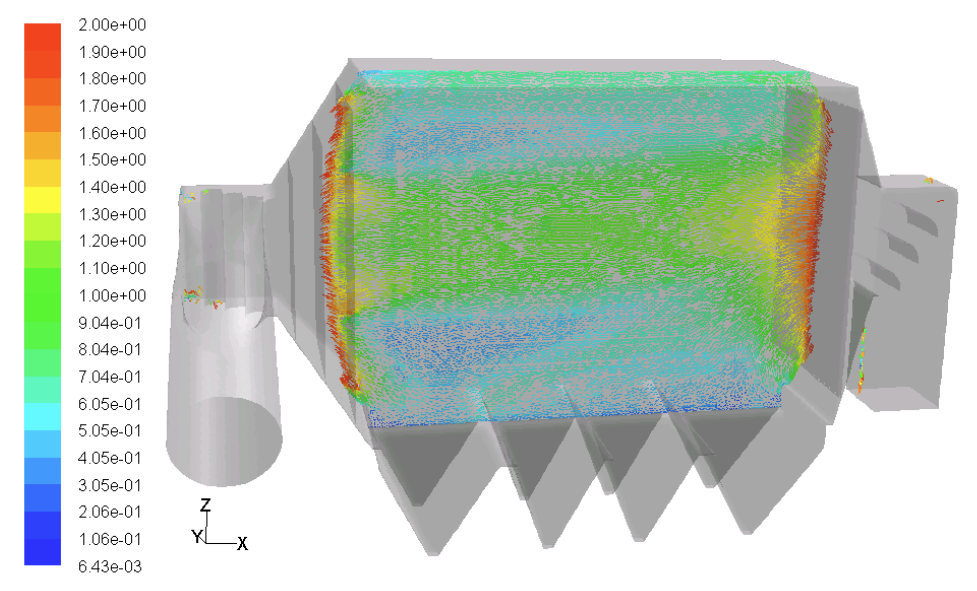
The practical application of this technology is clearly demonstrated in high-complexity systems like Electrostatic Precipitators, which are essential for dedusting in iron ore pelletizing processes. In fundamental studies, such as those developed by Favalli et al., it is observed that CFD allows for the redesign of Flow Deflector Plates to achieve a much more uniform velocity distribution. This improvement in the flow profile significantly increases the dust collection rate, even before considering electric field effects, proving how the equipment’s internal geometry is a decisive factor in meeting environmental targets. Furthermore, the ability to validate these numerical models with experimental pressure drop data provides engineering teams with the technical confidence required for large-scale investments.
Velocity field in an electrostatic precipitator (Favalli et al.).
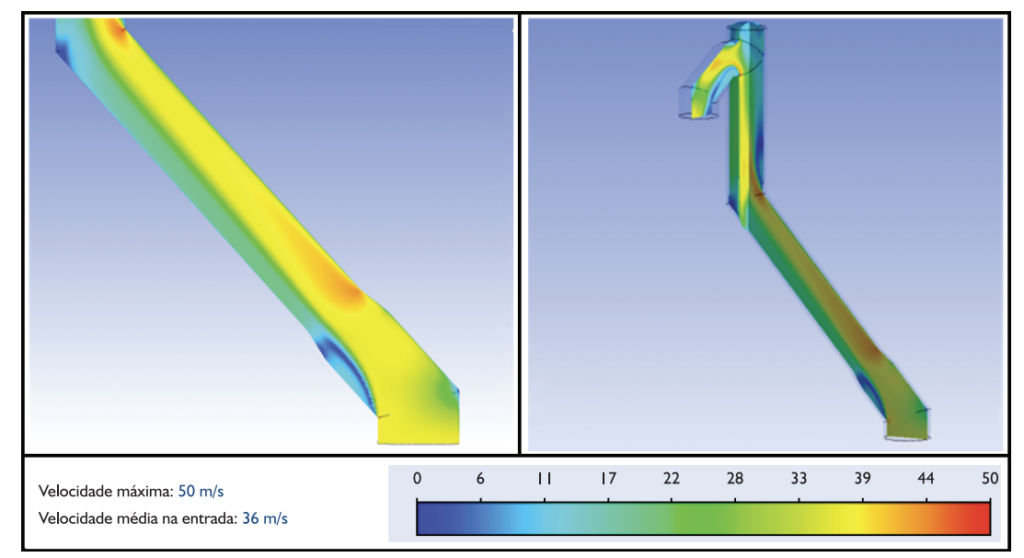
Similarly, in the steel industry, treating exhaust gases from Basic Oxygen Furnace (BOF) converters presents immense thermal and mechanical challenges, where duct failure can lead to severe fugitive emissions. As detailed by Sartim et al., computational simulation can reveal hidden wear mechanisms, such as erosion due to high-velocity particle impingement on walls and abrasion caused by the fallback of heavier material in low-velocity zones. Understanding these phenomena allows plants to implement precise geometric modifications to hoods and ducts, extending component life and preventing unscheduled downtime that could compromise both productivity and the emission levels permitted by regulatory bodies.
Velocity field in a hood (Sartim et al.).
Beyond large-scale infrastructure, other essential solutions such as cyclones and baghouse filters also benefit significantly from CFD analysis. In the case of cyclones, simulation allows for the fine-tuning of the vortex trajectory, maximizing centrifugal particle separation without causing an excessive pressure drop that would increase energy consumption. For baghouse filters, CFD is used to ensure that the airflow is distributed equally among all filter elements, preventing premature wear of specific bags and ensuring the system operates within its maximum efficiency range. This approach is fundamental for industries of various sizes, including grain processing and cement manufacturing, where filtration efficiency directly impacts business sustainability.
Apart from stacks and ducts, CFD extends its value to dust control in logistics and material handling, such as belt conveyors and hopper systems. The integration of methods like CFD-DEM and CFD-DPM enables the design of new technologies, including spiral guide hoppers and optimized suppression spray systems. These solutions reduce particle velocity and improve the interaction between water droplets and ore fines, mitigating dust dispersion in the workspace. By replacing the old trial-and-error method with high-fidelity virtual prototypes, modern industries deliver solutions that balance high operational performance with non-negotiable respect for occupational health and environmental protection.
FAVALLI, R. C., et al. Aplicação de CFD em precipitadores eletrostáticos para siderurgia e mineração.
SARTIM, R., et al. Simulação computacional dos gases de exaustão dos sistemas de despoeiramento primário dos convertedores BOF da ArcelorMittal Tubarão.