Structural Simulation of Pressure Vessels According to ASME Section VIII Division 2
- VirtualCAE
- 26/05/2026
- Blog
- English, FEA, Finite element analysis
- 0 Comentários
Pressure vessels play a fundamental role in virtually every industrial sector involving the storage, processing, or transportation of fluids under controlled pressure conditions. Petrochemical, chemical, pharmaceutical, food processing, mining, pulp and paper, and power generation industries rely directly on these types of equipment to ensure operational continuity, process safety, and production stability.
In this context, VirtualCAE operates in the development and application of advanced structural simulations for pressure vessels, using computational engineering methodologies aligned with the requirements of ASME Section VIII Division 2, the leading international reference for the design and validation of pressurized equipment.
As demonstrated by VirtualCAE in highly critical projects involving CAE simulations applied to the certification of various devices and components subject to rigorous regulatory validation requirements, the company also applies this same expertise to structural analyses of industrial pressure vessels, ensuring a high level of technical reliability, traceability, and regulatory compliance.
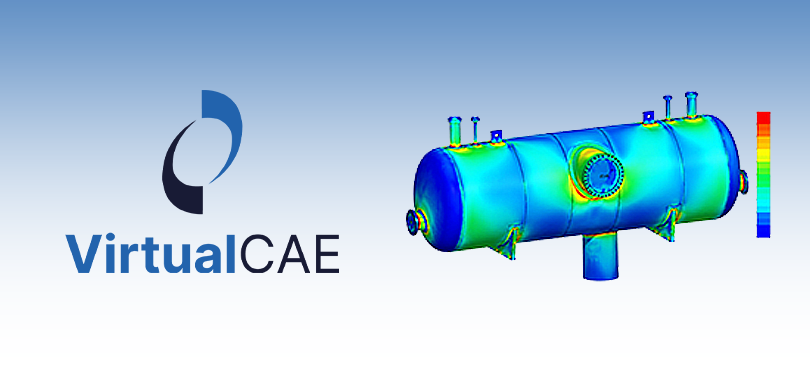
To meet these demands, VirtualCAE uses numerical simulations based on the Finite Element Method (FEA – Finite Element Analysis), enabling highly accurate prediction of the structural behavior of equipment still during the design phase. This approach reduces risks, anticipates potential failures, and enables more efficient and economically viable engineering decisions.
Computational Engineering Applied to Design by Analysis
ASME VIII Division 2 introduces the Design by Analysis philosophy, allowing computational analyses to partially replace excessively conservative approaches based solely on traditional analytical formulas. VirtualCAE operates precisely within this context, developing advanced numerical models capable of accurately representing the real behavior of pressure vessels under complex operating conditions.
Through the development of detailed three-dimensional models, VirtualCAE performs the complete representation of components such as the main shell, heads, nozzles, flanges, supports, structural reinforcements, geometric transition regions, and components subjected to stress concentrations.
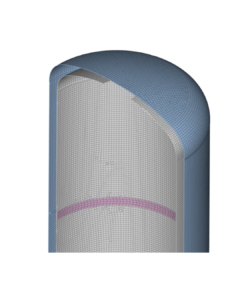
After modeling, the equipment is discretized into high-quality finite element meshes, enabling robust structural analyses fully compliant with ASME VIII Div. 2 Part 5 criteria.
VirtualCAE conducts complete structural analyses considering multiple operating conditions simultaneously, including internal and external pressure, equipment self-weight, piping loads, thermal gradients, thermal expansion, wind loads, seismic loads, transient startup and shutdown conditions, and combined load cases.
This approach allows the evaluation of the actual structural behavior of the equipment, enabling the early identification of critical regions and potential failure mechanisms.
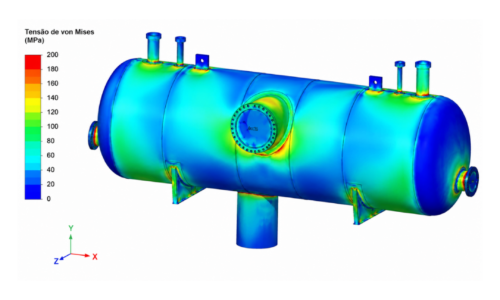
Based on the obtained results, ASME VIII Div. 2 provides specific criteria for interpretation and classification of calculated stresses. One of the most important aspects of this methodology is the distinction between primary, secondary, and peak stresses, since each type has a different impact on the structural integrity of the equipment.
This classification allows evaluation not only of whether the vessel withstands the applied loads, but also whether critical regions susceptible to localized failures, permanent deformations, or cumulative long-term damage exist.
One of the primary failure modes evaluated according to ASME VIII Div. 2 is plastic collapse. This verification aims to ensure that the equipment maintains its structural capacity without undergoing generalized plastic deformation under extreme loading conditions.
In more complex geometries, especially in regions near nozzles and thickness transitions, localized failure analysis becomes equally relevant, since excessive stress concentrations may compromise the equipment’s service life even when global stresses appear to remain within acceptable limits.
Plastic Collapse Assessment
VirtualCAE performs analyses to verify the structural capacity of the equipment under extreme loading conditions, ensuring that generalized plastic deformations capable of compromising the safe operation of the pressure vessel do not occur.
Buckling Analysis
Equipment subjected to external pressure or compressive loads may exhibit critical structural instabilities even before material yielding occurs. Therefore, we use nonlinear simulations for accurate identification of buckling risks and structural optimization of the design.
Fatigue Analysis
For equipment subjected to thermal cycles or frequent pressure variations, VirtualCAE performs fatigue analyses, enabling estimation of fatigue life in cycles, prediction of crack initiation, and improvement of the operational durability of the equipment.
Structural Optimization and Cost Reduction
In addition to regulatory validation, we use structural simulation as a strategic design optimization tool. Computational engineering enables precise understanding of the actual stress distribution within the equipment, reducing overdesign and enabling:
- Thickness reduction;
- Structural mass reduction;
- Lower raw material consumption;
- Manufacturing cost reduction;
- Logistics and assembly optimization;
- Increased operational reliability.
This approach provides direct gains in industrial competitiveness without compromising safety and performance requirements.
VirtualCAE’s activities are based on the strategic use of computational engineering applied to the validation of highly critical industrial products and equipment. The company employs advanced CAE (Computer-Aided Engineering) methodologies to support manufacturers in developing safer, more efficient solutions aligned with international regulatory requirements.
As in applications involving complex certifications and multiphysics analyses, VirtualCAE applies its expertise in structural simulation of pressure vessels to provide highly specialized technical support throughout all stages of equipment development.
Conclusion
Structural simulation of pressure vessels according to ASME Section VIII Division 2 currently represents one of the most advanced applications of computational engineering in industry. More than simply validating stresses or minimum thicknesses, this methodology enables deep understanding of the structural behavior of equipment under real operating conditions.
VirtualCAE operates directly within this scenario, offering advanced simulation-based engineering solutions for structural validation, mechanical integrity assessment, and optimization of pressurized equipment.
Through the integration of computational modeling, numerical analysis, and regulatory compliance, the company contributes to the development of safer, more reliable, efficient, and competitive pressure vessels for modern industry.
Related Posts
Simulando Transferência de Calor
- VirtualCAE
- 06/06/2025
A simulação de transferência de calor é um aspecto crucial na análise e otimização de pr ..
Simulação Virtual do Teste de ROPS
- VirtualCAE
- 30/08/2023
ROPS refere-se a Roll-Over Protective Structures, que são estruturas projetadas para ..