Ensuring operational safety and compliance with operational requirements.
Helicopter operations on offshore platforms are among the most critical points of operational safety in the oil and gas sector. The helideck must ensure adequate landing and take-off conditions even in adverse environments, subject to strong winds, turbulence induced by structural obstacles, and thermal effects from nearby exhausts. To meet this challenge, Computational Fluid Dynamics (CFD) has become an indispensable tool, enabling detailed simulations that help understand and mitigate the risks associated with airflow around installations (ZHANG et al., 2020).
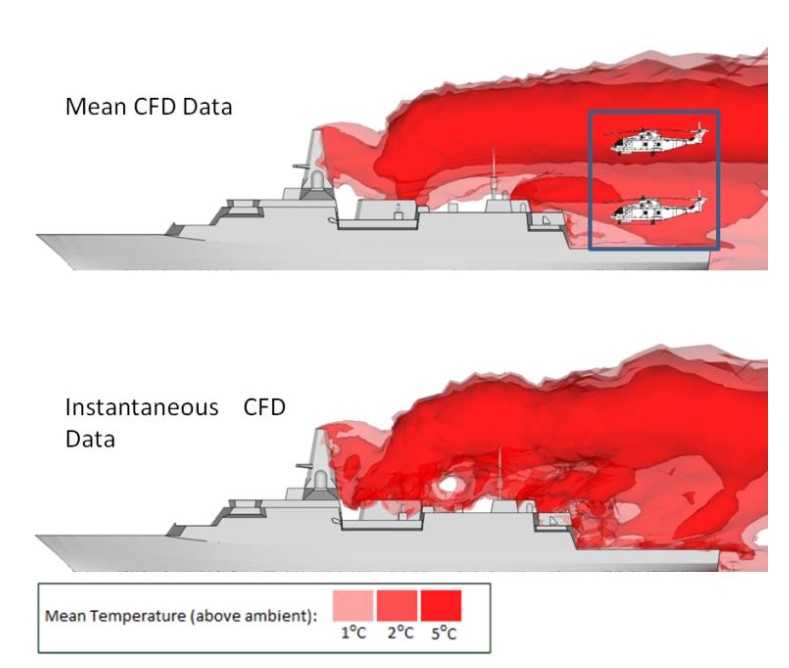
Analysis of the effect of the thermal plume on a helideck (SCOTT; WHITE; OWEN, 2015).
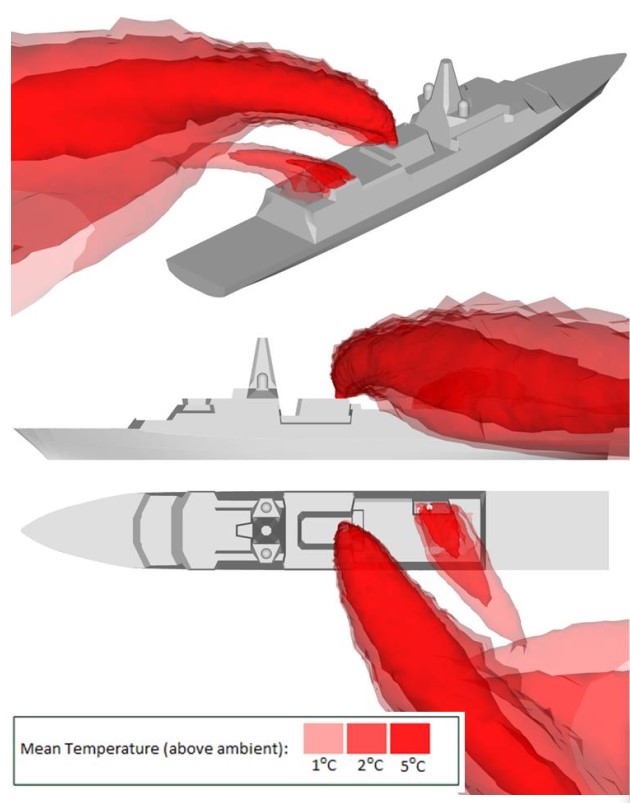
CFD analyses provide an accurate view of the interaction between wind and the complex geometry of platforms. Through them, it is possible to identify recirculation zones, persistent vortices, and regions of high turbulence that can compromise helicopter stability during the most sensitive flight phases. In addition, the simulation makes it possible to assess how hot gases from turbines and exhaust systems affect the local temperature, creating thermal gradients capable of reducing lift during aircraft approach (ABU-AL-SHAIEB et al., 2023).
Analysis of the effect of wind on the thermal plume on a helideck (SCOTT; WHITE; OWEN, 2015).
International and national standards, such as NORSOK C-004, CAP 437, and NORMAN-223, establish limits for critical parameters, especially vertical wind speed and turbulence levels above the helideck. These criteria are used to define safe operating conditions, distinguishing between perceptible turbulence scenarios and those that already represent flight limitations. Numerical modeling, in this context, makes it possible to verify whether the helideck design complies with these requirements and provides support for engineering adjustments. Among the measures that can be evaluated are the optimization of the helideck’s height in relation to heat sources (air-gap), the repositioning of exhausts, and the analysis of the influence of cranes, towers, and modules that alter wind patterns (ABU-AL-SHAIEB et al., 2023).
Another important aspect is the selection of the turbulence model used in simulations. Studies show that the choice of model directly influences the accuracy of results, especially in recirculation regions and areas near the platform (SCHLATTER; ANDERSSON; OLOFSSON, 2021). Models based on turbulent energy offer advantages in balancing computational cost and physical realism, reinforcing the need for careful evaluations in each project. By integrating regulatory criteria, experimental validations, and simulation results, it is possible to obtain reliable analyses that support engineering decisions and safety audits.
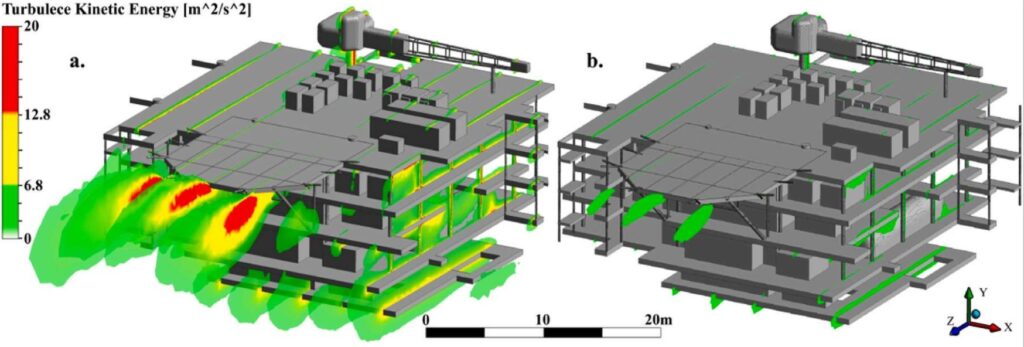
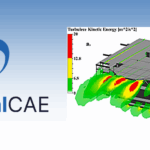
Analysis of turbulence on a helideck (ABU-AL-SHAIEB et al., 2023).
The use of CFD in helidecks goes beyond regulatory validation. It becomes a strategic differential by enabling the prediction of critical wind and turbulence scenarios, the optimization of platform layout, and the reduction of risks during aerial operations. Thus, computational simulation consolidates itself as a link between operational safety, offshore transport efficiency, and innovation in engineering design.
ABU-AL-SHAIEB, M.; ALSHAREEF, A.; ALI, S.; ALSAGRI, A. Evaluation of wind-induced turbulence around offshore platforms in different wind speeds and directions, along with safety assessment of helicopter operation and helideck’s air-gap optimization. Journal of Wind Engineering and Industrial Aerodynamics, v. 233, p. 105299, 2023.
SCHLATTER, P.; ANDERSSON, U.; OLOFSSON, K. On turbulence criteria and model requirements for numerical simulation of turbulent flows above offshore helidecks. Journal of Wind Engineering and Industrial Aerodynamics, v. 216, p. 104723, 2021.
ZHANG, X.; WANG, L.; KHALIL, M.; LI, Y. CFD analysis for offshore systems. Ocean Engineering, v. 218, p. 108230, 2020.